Population Microsimulation
Overview
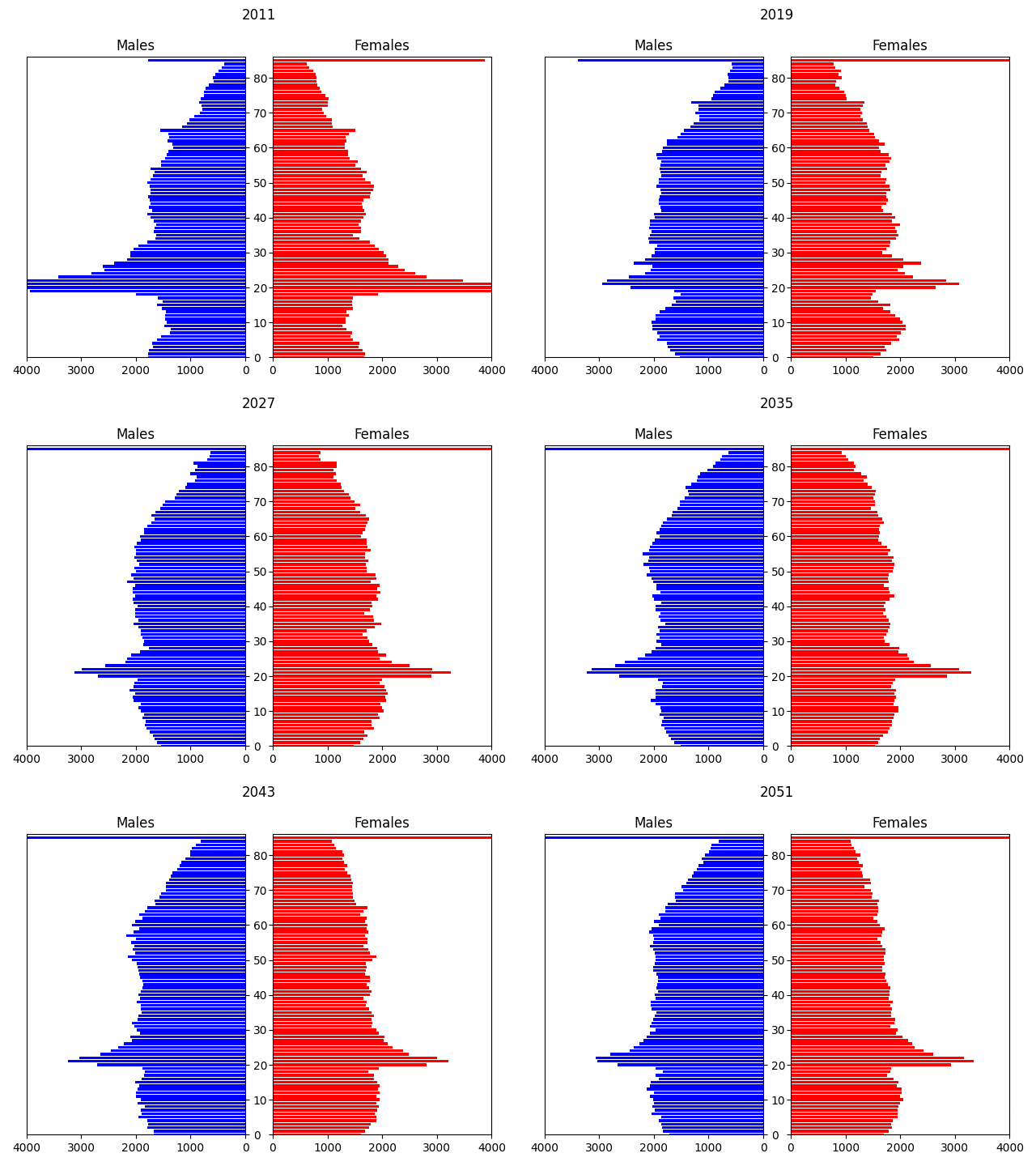
In this example, the input data is a csv file containing a microsynthesised 2011 population of Newcastle generated from UK census data, by area (MSOA), age, gender and ethnicity. The transitions modelled are: ageing, births, deaths and migrations, over a period of 40 years to 2051.
Births, deaths and migrations (applied in that order) are modelled using Monte-Carlo simulation (sampling Poisson processes in various ways) using distributions parameterised by age, sex and ethnicity-specific fertility, mortality and migration rates respectively, which are largely fictitious (but inspired by data from the NewETHPOP[1] project).
For the fertility model newborns simply inherit their mother's location and ethnicity, are born aged zero, and have a randomly selected gender (with even probability). The migration model is an 'in-out' model, i.e. it is not a full origin-destination model. Flows are either inward from 'elsewhere' or outward to 'elsewhere'.
People who have died, and outward migrations are simply removed from the population. (In a larger-scale model migrations could be redistributed).
At each timestep the check method computes and displays some summary data:
- the time
- the size of the population
- the mean age of the population
- the percentage of the population that are female
- the in and out migration numbers
Examples Source Code
The code for all the examples can be obtained by either:
Setup
"""
model.py: Population Microsimulation - births, deaths and migration by age, gender and ethnicity
"""

import time
from datetime import date

from dateutil.relativedelta import relativedelta
from population import Population  # ty:ignore[unresolved-import]

import neworder

# neworder.verbose()

# input data
initial_population = "examples/people/E08000021_MSOA11_2011.csv"
# age, gender and ethnicity-specific rates
fertility_rate_data = "examples/people/fertility.csv"
mortality_rate_data = "examples/people/mortality.csv"
in_migration_rate_data = "examples/people/migration-in.csv"
out_migration_rate_data = "examples/people/migration-out.csv"

# define the evolution timeline
timeline = neworder.CalendarTimeline(date(2011, 1, 1), relativedelta(years=1), end=date(2051, 1, 1))

# create the model
population = Population(
    timeline,
    initial_population,
    fertility_rate_data,
    mortality_rate_data,
    in_migration_rate_data,
    out_migration_rate_data,
)

# run the model
start = time.time()
ok = neworder.run(population)
neworder.log("run time = %.2fs" % (time.time() - start))
assert ok
Model Implementation
Births, deaths and outward migrations are modelled with Bernoulli trials with hazard rates parameterised by age, sex and ethnicity. Inward migrations are modelled by sampling counts from a Poisson process with the intensity parameterised by age, sex and ethnicity.
population.py:
"""
population.py: Model implementation for population microsimulation
"""

from pathlib import Path

import numpy as np
import pandas as pd
import pyramid  # ty:ignore[unresolved-import]

import neworder


class Population(neworder.Model):
    def __init__(
        self,
        timeline: neworder.Timeline,
        population_file: str,
        fertility_file: str,
        mortality_file: str,
        in_migration_file: str,
        out_migration_file: str,
    ):
        super().__init__(timeline, neworder.MonteCarlo.deterministic_identical_stream)

        # extract the local authority code from the filename
        self.lad = Path(population_file).name.split("_")[0]

        self.population = pd.read_csv(population_file)
        self.population.set_index(neworder.df.unique_index(len(self.population)), inplace=True, drop=True)

        # these datasets use a multiindex of age, gender and ethnicity
        # out migration is a hazard rate
        # in migration is the intensity of a Poisson process (not a hazard on existing residents!)
        self.fertility = pd.read_csv(fertility_file, index_col=[0, 1, 2])
        self.mortality = pd.read_csv(mortality_file, index_col=[0, 1, 2])
        self.in_migration = pd.read_csv(in_migration_file, index_col=[0, 1, 2])
        self.out_migration = pd.read_csv(out_migration_file, index_col=[0, 1, 2])

        # make gender and age categorical
        self.population.DC1117EW_C_AGE = self.population.DC1117EW_C_AGE.astype("category")  # ty:ignore[unresolved-attribute]
        self.population.DC1117EW_C_SEX = self.population.DC1117EW_C_SEX.astype("category")  # ty:ignore[unresolved-attribute]

        # actual age is randomised within the bound of the category (NB category values are age +1)
        self.population["Age"] = self.population.DC1117EW_C_AGE.astype(int) - self.mc.ustream(len(self.population))

        self.fig = None
        self.plot_pyramid()

    def step(self) -> None:
        self.births()
        self.deaths()
        self.migrations()
        self.age()

    def finalise(self) -> None:
        pass

    def age(self) -> None:
        # Increment age by timestep and update census age category (used for ASFR/ASMR lookup)
        # NB census age category max value is 86 (=85 or over)
        self.population.Age = (  # ty:ignore[invalid-assignment]
            self.population.Age + 1
        )  # NB self.timeline.dt wont be exactly 1 as based on an average length year of 365.2475 days
        # reconstruct census age group
        self.population.DC1117EW_C_AGE = np.clip(np.ceil(self.population.Age), 1, 86).astype(int)  # ty:ignore[invalid-assignment]

    def births(self) -> None:
        # First consider only females
        females = self.population[self.population.DC1117EW_C_SEX == 2].copy()

        # Now map the appropriate fertility rate to each female
        # might be a more efficient way of generating this array
        rates = females.join(self.fertility, on=["NewEthpop_ETH", "DC1117EW_C_SEX", "DC1117EW_C_AGE"])[
            "Rate"
        ].to_numpy()
        # Then randomly determine if a birth occurred
        h = self.mc.hazard(rates * self.timeline.dt)

        # The babies are a clone of the new mothers, with with changed PID, reset age and randomised gender (keeping location and ethnicity)
        newborns = females[h == 1].copy()
        newborns.set_index(neworder.df.unique_index(len(newborns)), inplace=True, drop=True)
        newborns.Age = (
            self.mc.ustream(len(newborns)) - 1.0
        )  # born within the *next* 12 months (ageing step has yet to happen)
        newborns.DC1117EW_C_AGE = 1  # this is 0-1 in census category
        newborns.DC1117EW_C_SEX = 1 + self.mc.hazard(0.5, len(newborns)).astype(int)  # 1=M, 2=F

        self.population = pd.concat((self.population, newborns))

    def deaths(self) -> None:
        # Map the appropriate mortality rate to each person
        # might be a more efficient way of generating this array
        rates = self.population.join(self.mortality, on=["NewEthpop_ETH", "DC1117EW_C_SEX", "DC1117EW_C_AGE"])["Rate"]

        # Then randomly determine if a death occurred
        h = self.mc.hazard(rates.to_numpy() * self.timeline.dt)

        # Finally remove deceased from table
        self.population = self.population[h != 1]

    def migrations(self) -> None:
        # immigration:
        # - sample counts of migrants according to intensity
        # - append result to population

        self.in_migration["count"] = self.mc.counts(self.in_migration.Rate.to_numpy(), self.timeline.dt)
        h_in = self.in_migration.loc[self.in_migration.index.repeat(self.in_migration["count"])].drop(
            ["Rate", "count"], axis=1
        )
        h_in = h_in.reset_index().set_index(neworder.df.unique_index(len(h_in)))
        h_in["Area"] = self.lad
        # randomly sample exact age according to age group
        h_in["Age"] = h_in.DC1117EW_C_AGE - self.mc.ustream(len(h_in))

        # internal emigration:
        out_rates = self.population.join(self.out_migration, on=["NewEthpop_ETH", "DC1117EW_C_SEX", "DC1117EW_C_AGE"])[
            "Rate"
        ].to_numpy()
        h_out = self.mc.hazard(out_rates * self.timeline.dt)
        # add incoming & remove outgoing migrants
        self.population = pd.concat((self.population[h_out != 1], h_in))

        # record net migration
        self.in_out = (len(h_in), h_out.sum())

    def mean_age(self) -> float:
        return self.population.Age.mean()

    def gender_split(self) -> float:
        # this is % female
        return self.population.DC1117EW_C_SEX.mean() - 1.0

    def size(self) -> int:
        return len(self.population)

    def check(self) -> bool:
        """State of the nation"""
        # check no duplicated unique indices
        if len(self.population[self.population.index.duplicated(keep=False)]):
            neworder.log("Duplicate indices found")
            return False
        # Valid ETH, SEX, AGE
        if not np.array_equal(sorted(self.population.DC1117EW_C_SEX.unique()), [1, 2]):
            neworder.log("invalid gender value")
            return False
        if (
            min(self.population.DC1117EW_C_AGE.unique().astype(int)) < 1
            or max(self.population.DC1117EW_C_AGE.unique().astype(int)) > 86
        ):
            neworder.log("invalid categorical age value")
            return False
        # this can go below zero for cat 86+
        if (self.population.DC1117EW_C_AGE - self.population.Age).max() >= 1.0:
            neworder.log("invalid fractional age value")
            return False

        neworder.log(
            f"check OK: time={self.timeline.time} size={self.size()} mean_age={self.mean_age():.2f}, pct_female={100.0 * self.gender_split():.2f} net_migration={self.in_out[0] - self.in_out[1]} ({self.in_out[0]}-{self.in_out[1]})"
        )

        # if all is ok, plot the data
        self.plot_pyramid()

        return True  # Faith

    def plot_pyramid(self) -> None:
        a = np.arange(86)
        s = self.population.groupby(by=["DC1117EW_C_SEX", "DC1117EW_C_AGE"], observed=False)["DC1117EW_C_SEX"].count()
        m = s[s.index.isin([1], level="DC1117EW_C_SEX")].values
        f = s[s.index.isin([2], level="DC1117EW_C_SEX")].values

        if self.fig is None:
            self.fig, self.axes, self.mbar, self.fbar = pyramid.plot(a, m, f)
        else:
            # NB self.timeline.time is now the time at the *end* of the timestep since this is called from check() (as opposed to step())
            self.mbar, self.fbar = pyramid.update(
                str(self.timeline.time.year),
                self.fig,
                self.axes,
                self.mbar,
                self.fbar,
                a,
                m,
                f,
            )
Execution
To run the model:
Output
The model displays an animated population pyramid for the entire region being modelled (see above), plus some logging output with various statistics:
...
[py 0/1] check OK: time=2045-01-01 size=325865 mean_age=41.91, pct_female=49.46 net_migration=1202.0 (20320-19118.0)
[py 0/1] check OK: time=2046-01-01 size=326396 mean_age=41.91, pct_female=49.41 net_migration=787.0 (20007-19220.0)
[py 0/1] check OK: time=2047-01-01 size=327006 mean_age=41.88, pct_female=49.37 net_migration=921.0 (20252-19331.0)
[py 0/1] check OK: time=2048-01-01 size=327566 mean_age=41.87, pct_female=49.34 net_migration=780.0 (19924-19144.0)
[py 0/1] check OK: time=2049-01-01 size=328114 mean_age=41.84, pct_female=49.31 net_migration=824.0 (20140-19316.0)
[py 0/1] check OK: time=2050-01-01 size=328740 mean_age=41.81, pct_female=49.26 net_migration=826.0 (20218-19392.0)
[py 0/1] check OK: time=2051-01-01 size=329717 mean_age=41.77, pct_female=49.30 net_migration=1130.0 (20175-19045.0)
[py 0/1] run time = 17.19s
This 40 year simulation of an initial population of about 280,000 runs in under 20s on a single core of a medium-spec machine.