Wolf-sheep predation
Another implementation of a classic agent-based model
Examples Source Code
The code for all the examples can be obtained by either:
Implementation
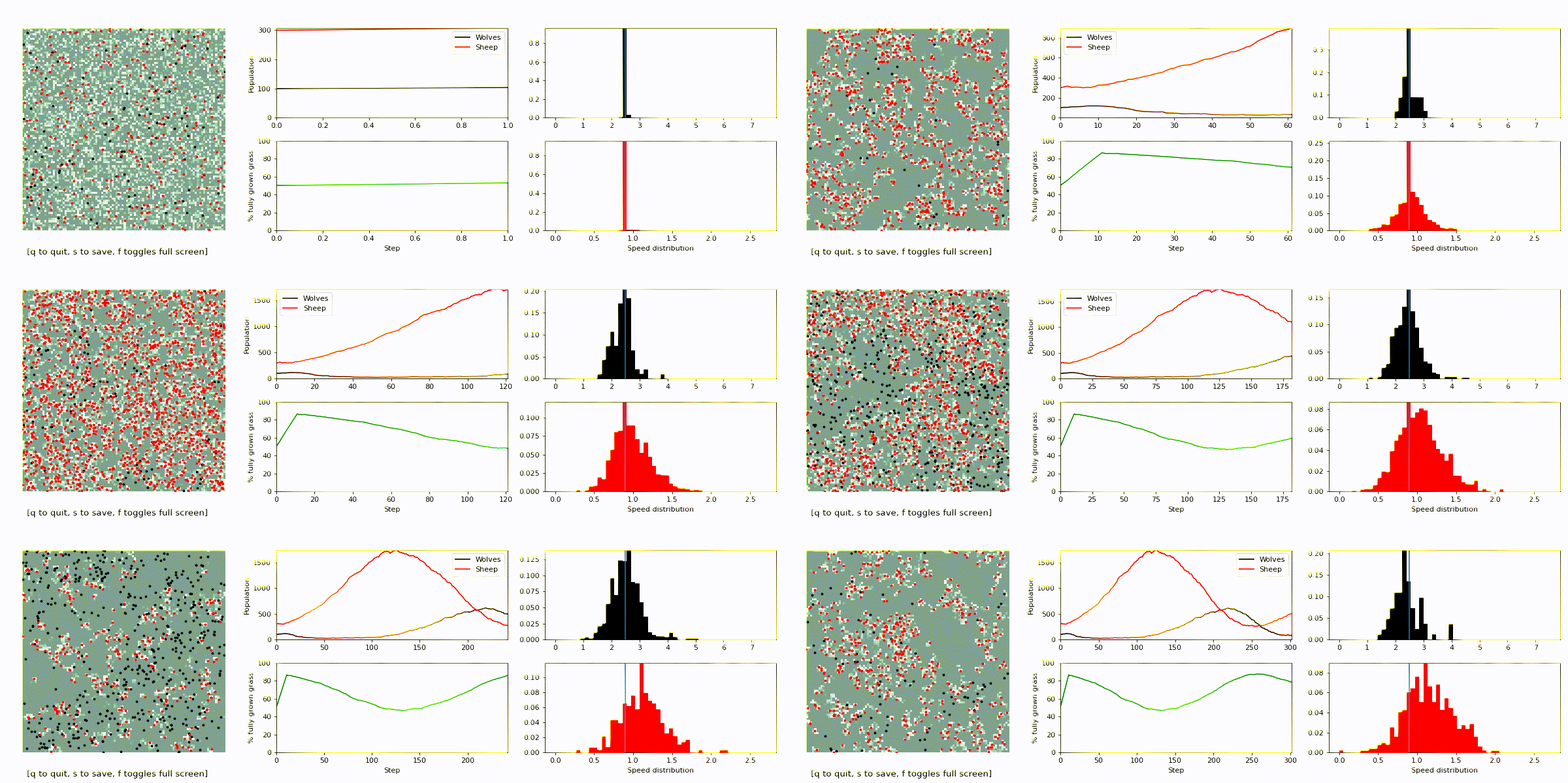
Rather than representing the agents (wolves, sheep, and grass) as objects, as would be typical in packages like netlogo or mesa, they are represented as individual rows in pandas DataFrames, which permits efficient vectorised operations on them. Grass grows in fixed "cells" which are used to process interactions. The wolves and sheep roam about randomly at a fixed speed: sheep can only eat grass that is fully grown in the cell they currently occupy, and wolves can only eat sheep within the cell they both occupy.
An extension to the original model adds natural selection: new agents inherit their parent's speed with a random "mutation". Faster animals tend to encounter food more frequently, but conversely consume energy more quickly. The graphic displays a histogram of the speed distributions for wolves and sheep.
Here's the implementation:
from typing import Any

import matplotlib.pyplot as plt
import numpy as np
import pandas as pd

import neworder as no

WOLF_COLOUR = "black"
SHEEP_COLOUR = "red"
GRASS_COLOUR = "green"


class WolfSheep(no.Model):
    def __init__(self, params: dict[str, Any]) -> None:
        super().__init__(no.LinearTimeline(0.0, 1.0), no.MonteCarlo.deterministic_independent_stream)
        # hard-coded to unit timestep
        self.width = params["grid"]["width"]
        self.height = params["grid"]["height"]
        self.domain = no.Space(np.array([0, 0]), np.array([self.width, self.height]), edge=no.Edge.WRAP)

        n_wolves = params["wolves"]["starting_population"]
        n_sheep = params["sheep"]["starting_population"]

        self.wolf_reproduce = params["wolves"]["reproduce"]
        self.sheep_reproduce = params["sheep"]["reproduce"]
        self.init_wolf_speed = params["wolves"]["speed"]
        self.init_sheep_speed = params["sheep"]["speed"]
        self.wolf_speed_stddev = np.sqrt(params["wolves"]["speed_variance"])
        self.sheep_speed_stddev = np.sqrt(params["sheep"]["speed_variance"])

        self.wolf_gain_from_food = params["wolves"]["gain_from_food"]
        self.sheep_gain_from_food = params["sheep"]["gain_from_food"]
        self.grass_regrowth_time = params["grass"]["regrowth_time"]

        ncells = self.width * self.height
        self.grass = pd.DataFrame(
            index=pd.Index(name="id", data=no.df.unique_index(ncells)),
            data={
                "x": np.tile(np.arange(self.width) + 0.5, self.height),
                "y": np.repeat(np.arange(self.height) + 0.5, self.width),
                # 50% initial probability of being fully grown, other states uniform
                "countdown": self.mc.sample(
                    ncells,
                    [0.5] + [0.5 / (self.grass_regrowth_time - 1)] * (self.grass_regrowth_time - 1),
                ),
            },
        )

        self.wolves = pd.DataFrame(
            index=pd.Index(name="id", data=no.df.unique_index(n_wolves)),
            data={
                "x": self.mc.ustream(n_wolves) * self.width,
                "y": self.mc.ustream(n_wolves) * self.height,
                "speed": self.init_wolf_speed,
                "energy": (self.mc.ustream(n_wolves) + self.mc.ustream(n_wolves)) * self.wolf_gain_from_food,
            },
        )
        self.__assign_cell(self.wolves)

        self.sheep = pd.DataFrame(
            index=pd.Index(name="id", data=no.df.unique_index(n_sheep)),
            data={
                "x": self.mc.ustream(n_sheep) * self.width,
                "y": self.mc.ustream(n_sheep) * self.height,
                "speed": self.init_sheep_speed,
                "energy": (self.mc.ustream(n_sheep) + self.mc.ustream(n_sheep)) * self.sheep_gain_from_food,
            },
        )
        self.__assign_cell(self.sheep)

        self.wolf_pop = [len(self.wolves)]
        self.sheep_pop = [len(self.sheep)]
        self.grass_prop = [100.0 * len(self.grass[self.grass.countdown == 0]) / len(self.grass)]
        self.wolf_speed = [self.wolves.speed.mean()]
        self.sheep_speed = [self.sheep.speed.mean()]
        self.wolf_speed_var = [self.wolves.speed.var()]
        self.sheep_speed_var = [self.sheep.speed.var()]
        self.t = [self.timeline.index]

        (
            self.ax_g,
            self.ax_w,
            self.ax_s,
            self.ax_t1,
            self.ax_wt,
            self.ax_st,
            self.ax_t2,
            self.ax_gt,
            self.ax_t3,
            self.ax_ws,
            self.b_ws,
            self.ax_t4,
            self.ax_ss,
            self.b_ss,
        ) = self.__init_plot()

        # no.log(self.wolves)
        # no.log(self.sheep)
        # no.log(self.grass)
        self.paused = False

        # seed numpy random generator using our generator (for reproducible normal samples)
        self.npgen = np.random.default_rng(self.mc.raw())

    def step(self) -> None:
        # step each population
        self.__step_grass()
        self.__step_wolves()
        self.__step_sheep()

    def check(self) -> bool:
        # record data
        self.t.append(self.timeline.index)
        self.wolf_pop.append(len(self.wolves))
        self.sheep_pop.append(len(self.sheep))
        self.grass_prop.append(100.0 * len(self.grass[self.grass.countdown == 0]) / len(self.grass))
        self.wolf_speed.append(self.wolves.speed.mean())
        self.sheep_speed.append(self.sheep.speed.mean())
        self.wolf_speed_var.append(self.wolves.speed.var())
        self.sheep_speed_var.append(self.sheep.speed.var())

        self.__update_plot()

        if self.wolves.empty and self.sheep.empty:
            no.log("Wolves and sheep have died out")
            self.halt()
        return True

    def __step_grass(self) -> None:
        # grow grass
        self.grass.countdown = np.clip(self.grass.countdown - 1, 0, None)  # ty:ignore[unresolved-attribute]

    def __step_wolves(self) -> None:
        # move wolves (wrapped) and update cell
        vx = (2 * self.mc.ustream(len(self.wolves)) - 1.0) * self.wolves.speed
        vy = (2 * self.mc.ustream(len(self.wolves)) - 1.0) * self.wolves.speed
        (self.wolves.x, self.wolves.y), _ = self.domain.move(
            (self.wolves.x, self.wolves.y), (vx, vy), 1.0, ungroup=True
        )

        # half of energy (initially) is consumed by moving
        self.wolves.energy -= 0.5 + 0.5 * self.wolves.speed / self.init_wolf_speed
        self.__assign_cell(self.wolves)

        # eat sheep if available
        diners = self.wolves.loc[self.wolves.cell.isin(self.sheep.cell)]
        self.wolves.loc[self.wolves.cell.isin(self.sheep.cell), "energy"] += self.wolf_gain_from_food
        # NB *all* the sheep in cells with wolves get eaten (or at least killed)
        self.sheep = self.sheep[~self.sheep.cell.isin(diners.cell)]

        # remove dead
        self.wolves = self.wolves[self.wolves.energy >= 0]

        # breed
        m = self.mc.hazard(self.wolf_reproduce, len(self.wolves))
        self.wolves.loc[m == 1, "energy"] /= 2
        cubs = self.wolves[m == 1].copy().set_index(no.df.unique_index(int(sum(m))))
        # evolve speed/burn rate from mother + random factor (don't allow to go <=0) should probably be lognormal
        cubs.speed = np.maximum(cubs.speed + self.npgen.normal(0.0, self.wolf_speed_stddev, len(cubs)), 0.1)
        self.wolves = pd.concat((self.wolves, cubs))

    def __step_sheep(self) -> None:
        # move sheep randomly (wrapped)
        vx = (2 * self.mc.ustream(len(self.sheep)) - 1.0) * self.sheep.speed
        vy = (2 * self.mc.ustream(len(self.sheep)) - 1.0) * self.sheep.speed
        (self.sheep.x, self.sheep.y), _ = self.domain.move((self.sheep.x, self.sheep.y), (vx, vy), 1.0, ungroup=True)
        self.sheep.energy -= 0.5 + 0.5 * self.sheep.speed / self.init_sheep_speed
        self.__assign_cell(self.sheep)

        # eat grass if available
        grass_available = self.grass.loc[self.sheep.cell]
        self.sheep.energy += (grass_available.countdown.values == 0) * self.sheep_gain_from_food
        self.grass.loc[self.sheep.cell, "countdown"] = self.grass.loc[self.sheep.cell, "countdown"].apply(
            lambda c: self.grass_regrowth_time if c == 0 else c
        )

        # remove dead
        self.sheep = self.sheep[self.sheep.energy >= 0]

        # breed
        m = self.mc.hazard(self.sheep_reproduce, len(self.sheep))
        self.sheep.loc[m == 1, "energy"] /= 2
        lambs = self.sheep[m == 1].copy().set_index(no.df.unique_index(int(sum(m))))
        # evolve speed from mother + random factor
        lambs.speed = np.maximum(
            lambs.speed + self.npgen.normal(0.0, self.sheep_speed_stddev, len(lambs)),
            0.1,
        )
        self.sheep = pd.concat((self.sheep, lambs))

    def __assign_cell(self, agents: pd.DataFrame) -> None:
        # not ints for some reason
        agents["cell"] = (agents.x.astype(int) + self.width * agents.y.astype(int)).astype(int)

    def __init_plot(self) -> tuple[Any, ...]:
        plt.ion()

        self.figs = plt.figure(figsize=(15, 5))
        self.figs.suptitle("[q to quit, s to save, f toggles full screen]", y=0.05, x=0.15)
        gs = self.figs.add_gridspec(2, 3)
        ax0 = self.figs.add_subplot(gs[:, 0])
        ax1 = self.figs.add_subplot(gs[0, 1])
        ax2 = self.figs.add_subplot(gs[1, 1])

        ax3 = self.figs.add_subplot(gs[0, 2])
        ax4 = self.figs.add_subplot(gs[1, 2])

        # agent map
        ax_g = ax0.imshow(
            np.flip(self.grass.countdown.to_numpy().reshape(self.height, self.width), axis=0),
            extent=(0, self.width, 0, self.height),
            cmap="Greens_r",
            alpha=0.5,
        )
        ax_w = ax0.scatter(self.wolves.x, self.wolves.y, s=6, color=WOLF_COLOUR)
        ax_s = ax0.scatter(self.sheep.x, self.sheep.y, s=6, color=SHEEP_COLOUR)
        ax0.set_axis_off()

        # wolf and sheep population
        ax_wt = ax1.plot(self.t, self.wolf_pop, color=WOLF_COLOUR)
        ax_st = ax1.plot(self.t, self.sheep_pop, color=SHEEP_COLOUR)
        ax1.set_xlim((0, 100))
        ax1.set_ylim((0, max(self.wolf_pop[0], self.sheep_pop[0])))
        ax1.set_ylabel("Population")
        ax1.legend(["Wolves", "Sheep"])

        # grass
        ax_gt = ax2.plot(0, self.grass_prop[0], color=GRASS_COLOUR)
        ax2.set_xlim((0, 100))
        ax2.set_ylim((0.0, 100.0))
        ax2.set_ylabel("% fully grown grass")
        ax2.set_xlabel("Step")

        # wolf speed distribution

        bins = np.linspace(0, self.init_wolf_speed * 3.0, 51)
        width = self.init_wolf_speed * 3.0 / 50
        _, b_ws, ax_ws = ax3.hist([self.init_wolf_speed], bins=bins, width=width, color=WOLF_COLOUR)
        # ax3.set_xlabel("Speed distribution")
        ax3.axvline(self.init_wolf_speed)

        # sheep speed distribution
        bins = np.linspace(0, self.init_sheep_speed * 3.0, 51)
        width = self.init_sheep_speed * 3.0 / 50
        _, b_ss, ax_ss = ax4.hist([self.init_sheep_speed], bins=bins, width=width, color=SHEEP_COLOUR)
        ax4.set_xlabel("Speed distribution")
        ax4.axvline(self.init_sheep_speed)

        plt.tight_layout()

        self.figs.canvas.mpl_connect("key_press_event", lambda event: self.halt() if event.key == "q" else None)  # ty:ignore[unresolved-attribute]

        self.figs.canvas.flush_events()

        return (
            ax_g,
            ax_w,
            ax_s,
            ax1,
            ax_wt,
            ax_st,
            ax2,
            ax_gt,
            ax3,
            ax_ws,
            b_ws,
            ax4,
            ax_ss,
            b_ss,
        )

    def __update_plot(self) -> None:
        self.ax_g.set_data(np.flip(self.grass.countdown.to_numpy().reshape(self.height, self.width), axis=0))
        self.ax_w.set_offsets(np.c_[self.wolves.x, self.wolves.y])
        self.ax_s.set_offsets(np.c_[self.sheep.x, self.sheep.y])

        self.ax_wt[0].set_data(self.t, self.wolf_pop)
        self.ax_st[0].set_data(self.t, self.sheep_pop)
        self.ax_t1.set_xlim((0, self.t[-1]))
        self.ax_t1.set_ylim((0, max(max(self.wolf_pop), max(self.sheep_pop))))

        self.ax_gt[0].set_data(self.t, self.grass_prop)
        self.ax_t2.set_xlim((0, self.t[-1]))

        if not self.wolves.empty:
            n, _bins = np.histogram(self.wolves.speed, bins=self.b_ws)
            for rect, h in zip(self.ax_ws, n / len(self.wolves), strict=False):
                rect.set_height(h)
            self.ax_t3.set_ylim([0, max(n / len(self.wolves))])

        if not self.sheep.empty:
            n, _bins = np.histogram(self.sheep.speed, bins=self.b_ss)
            for rect, h in zip(self.ax_ss, n / len(self.sheep), strict=False):
                rect.set_height(h)
            self.ax_t4.set_ylim([0, max(n / len(self.sheep))])

        # plt.savefig("/tmp/wolf-sheep%04d.png" % self.timeline.index, dpi=80)
        self.figs.canvas.flush_events()
Which is run like so:
from wolf_sheep import WolfSheep  # ty:ignore[unresolved-import]

import neworder as no

# no.verbose()

assert no.mpi.RANK == 0 and no.mpi.SIZE == 1, "this example should only be run in serial mode"

params = {
    "grid": {"width": 100, "height": 100},
    "wolves": {
        "starting_population": 100,
        "reproduce": 0.05,
        "speed": 2.5,
        "speed_variance": 0.05,
        "gain_from_food": 20,
    },
    "sheep": {
        "starting_population": 300,
        "reproduce": 0.04,
        "speed": 0.9,
        "speed_variance": 0.02,
        "gain_from_food": 4,
    },
    "grass": {"regrowth_time": 12},
}

m = WolfSheep(params)

no.run(m)
Outputs
The main output (see image above) is an animation depicting the wolves, sheep and grass in the domain, plus graphs of the populations and histograms of the wolf and sheep speeds. Log messages also record when either the wolf or sheep populations die out completely. The model halts when the wolf and sheep populations die out.